
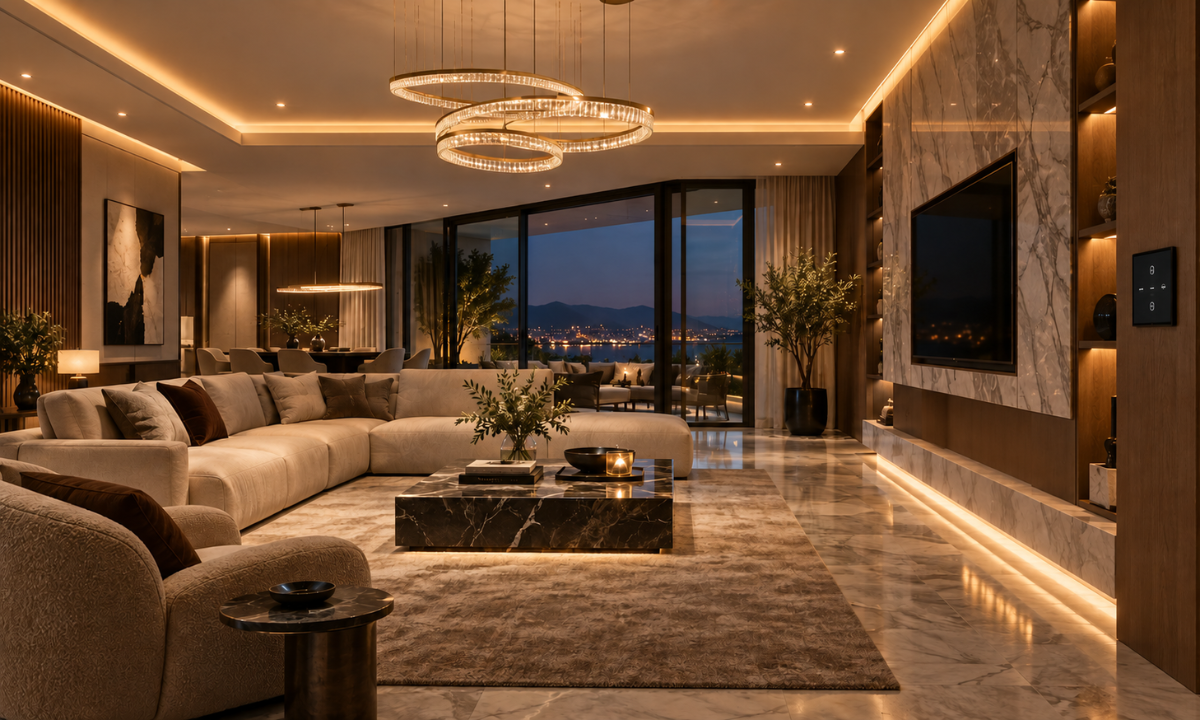
Luxury Home Lighting Automation: Smart Lighting Ideas for Elegant Interiors
Lighting is one of the most important elements of a luxury interior.
The right lighting can make marble look richer, highlight architectural details, create warmth in a bedroom and completely change the atmosphere of a living room. But luxury lighting is no longer only about choosing beautiful fixtures.
With luxury home lighting automation, homeowners can control brightness, colour temperature, lighting scenes and individual zones according to how they use each space.
Instead of manually switching several lights on and off, an automated lighting system allows the home to respond to different activities, times of day and personal preferences.
At TheAEK, lighting is considered as part of the overall interior design. The objective is not simply to automate lights, but to create an environment where lighting, architecture, materials and everyday living work together seamlessly.
What Is Luxury Home Lighting Automation?
Luxury home lighting automation is the use of smart controls, sensors, software and connected lighting systems to automatically manage different lights throughout a residence.
Depending on the project, homeowners can control:
- Ambient lighting
- Accent lighting
- Task lighting
- Decorative lighting
- Cove lighting
- Wall lights
- Pendant lights
- Landscape lighting
- Bedroom lighting
- Staircase lighting
- Outdoor lighting
These lights can be controlled through:
- Wall keypads
- Touch panels
- Mobile applications
- Voice commands
- Motion sensors
- Occupancy sensors
- Timers
- Automated scenes
- Centralised control systems
The result is a lighting system that can adapt to the way the home is being used.
Why Lighting Automation Matters in Luxury Homes
A luxury residence may have dozens or even hundreds of individual lighting points.
A large living room may contain:
- Cove lighting
- Chandeliers
- Spotlights
- Wall washers
- Floor lamps
- Decorative lights
- Artwork lighting
- Accent lighting
Controlling each light independently can become inconvenient.
Automation allows multiple lights to work together.
For example, a single button can create an evening lighting scene by:
- Dimming ceiling lights
- Turning on wall lights
- Activating cove lighting
- Highlighting artwork
- Adjusting decorative fixtures
This creates a more comfortable experience while reducing unnecessary controls on the walls.
1. Automated Lighting Scenes
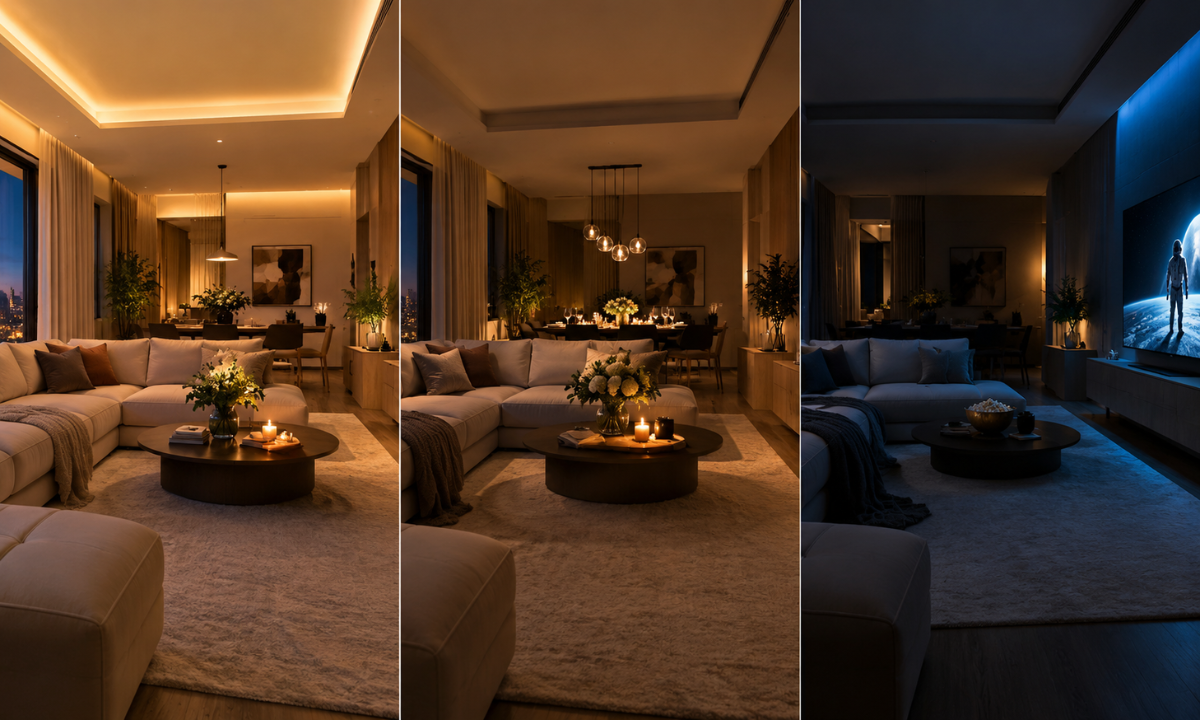
Lighting scenes are one of the most useful features of home lighting automation.
A scene combines multiple lighting settings into one command.
For example:
Morning Scene
- Gradually increase bedroom lighting
- Open selected curtains
- Activate soft hallway lighting
- Keep decorative lighting switched off
Evening Scene
- Reduce bright overhead lighting
- Increase warm ambient lighting
- Activate selected accent lights
- Highlight architectural features
Dinner Scene
- Dim general lighting
- Focus light over the dining table
- Activate decorative lighting
- Reduce surrounding brightness
Movie Scene
- Dim living room lights
- Switch off unnecessary fixtures
- Activate subtle pathway lighting
- Coordinate with the entertainment system
Goodnight Scene
- Switch off common-area lighting
- Keep low-level pathway lights active
- Reduce bedroom lighting
- Turn off selected outdoor lights
The homeowner does not need to control each fixture individually.
One command can change the atmosphere of the entire room.
2. Automated Ambient Lighting
Ambient lighting provides the general illumination of a room.
In luxury interiors, it should rarely feel harsh or excessive.
Automated dimming allows homeowners to adjust the brightness according to the time and activity.
For example, a living room might use brighter ambient lighting during the day and a softer setting during the evening.
This makes the space more adaptable without changing the physical fixtures.
3. Smart Accent Lighting
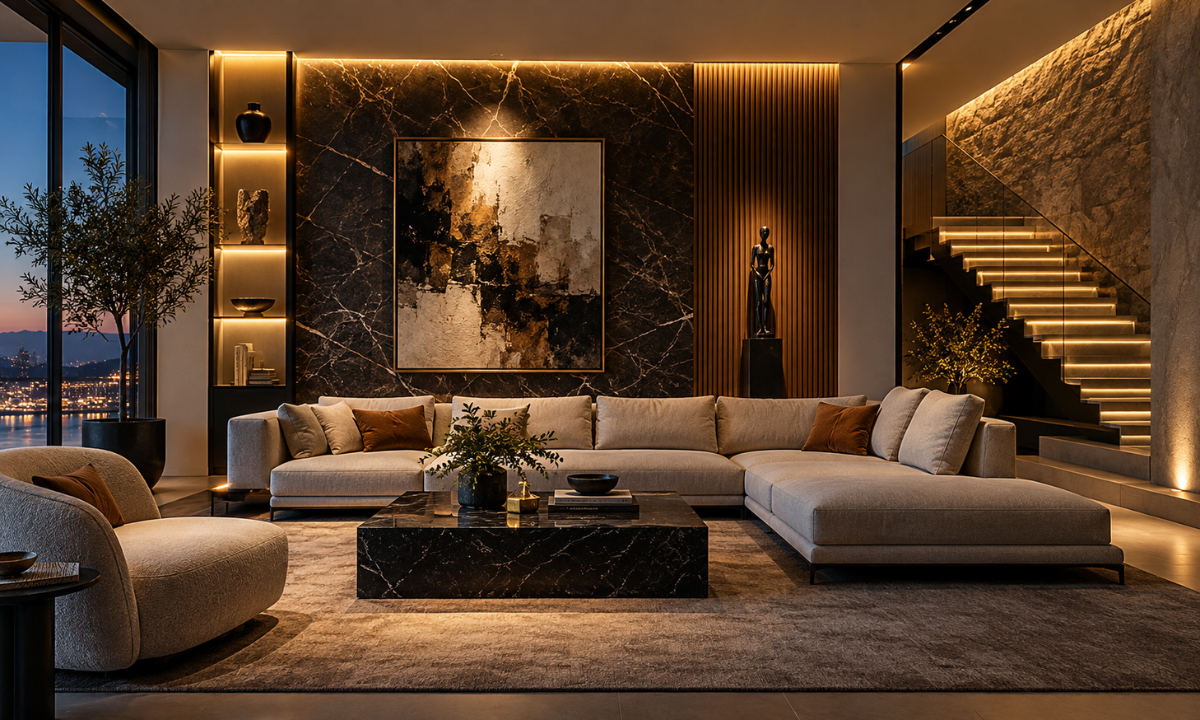
Accent lighting is particularly important in high-end interiors because it draws attention to specific architectural or decorative features.
It can be used to highlight:
- Artwork
- Sculptures
- Marble walls
- Veneer
- Stone
- Textured walls
- Display cabinets
- Architectural niches
- Decorative objects
Automation allows accent lighting to become part of different scenes.
For example, artwork lighting can be activated during entertaining while remaining off when the room is being used casually.
TheAEK’s Luxury Wallpaper & Wall Texture Ideas explores how textures and materials can become visual focal points. Appropriate accent lighting can further emphasise these surfaces.
4. Dimmable Lighting Automation
Dimming is one of the simplest ways to improve a lighting system.
Instead of having only two options—on or off—dimmable lighting allows the brightness to be adjusted according to the situation.
For example:
100% brightness: Cleaning or detailed tasks
70% brightness: Everyday activity
50% brightness: Relaxing
30% brightness: Entertaining
10% brightness: Night-time movement
The exact levels depend on the room, fixture and lighting design.
The important point is that lighting becomes adjustable rather than fixed.
5. Tunable White Lighting
Tunable white lighting allows the colour temperature of suitable lighting fixtures to be adjusted.
A lighting system can move between cooler and warmer white tones depending on the time of day and desired atmosphere.
For example:
- Cooler light for focused daytime activity
- Neutral light for general use
- Warmer light for evening relaxation
This can make a home feel more dynamic throughout the day.
For a luxury residence, tunable lighting can be particularly useful when combined with automated scenes.
6. Automated Bedroom Lighting
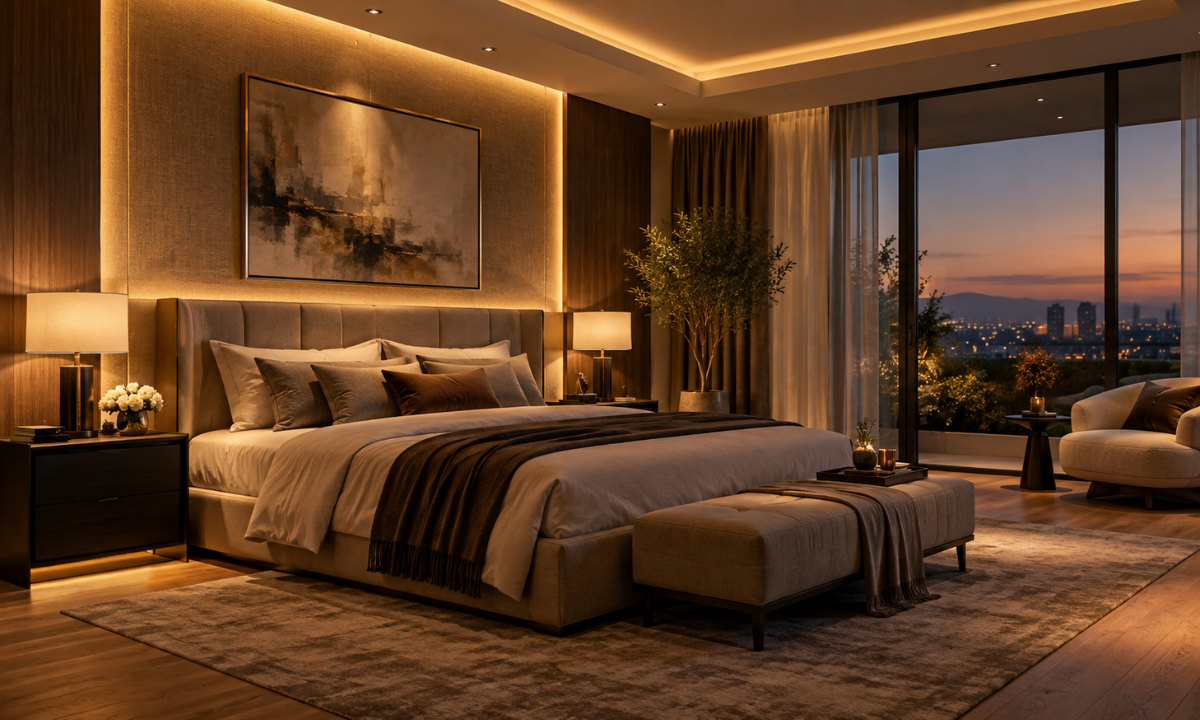
Bedrooms benefit significantly from lighting automation.
A bedside control can manage several functions without requiring the homeowner to walk around the room.
For example, a “Sleep” scene can:
- Turn off the main ceiling lights
- Dim bedside lights
- Activate low-level pathway lighting
- Switch off selected areas of the home
A “Wake Up” scene can gradually increase lighting rather than suddenly switching on bright overhead fixtures.
The result is a more comfortable daily routine.
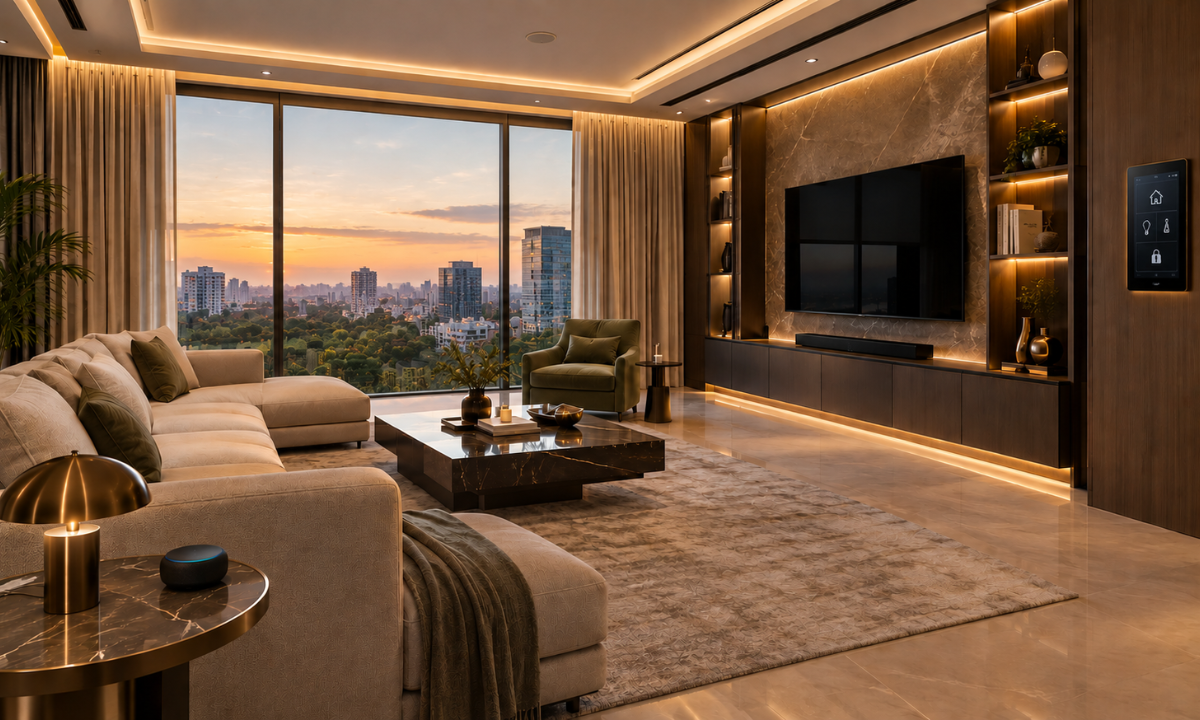
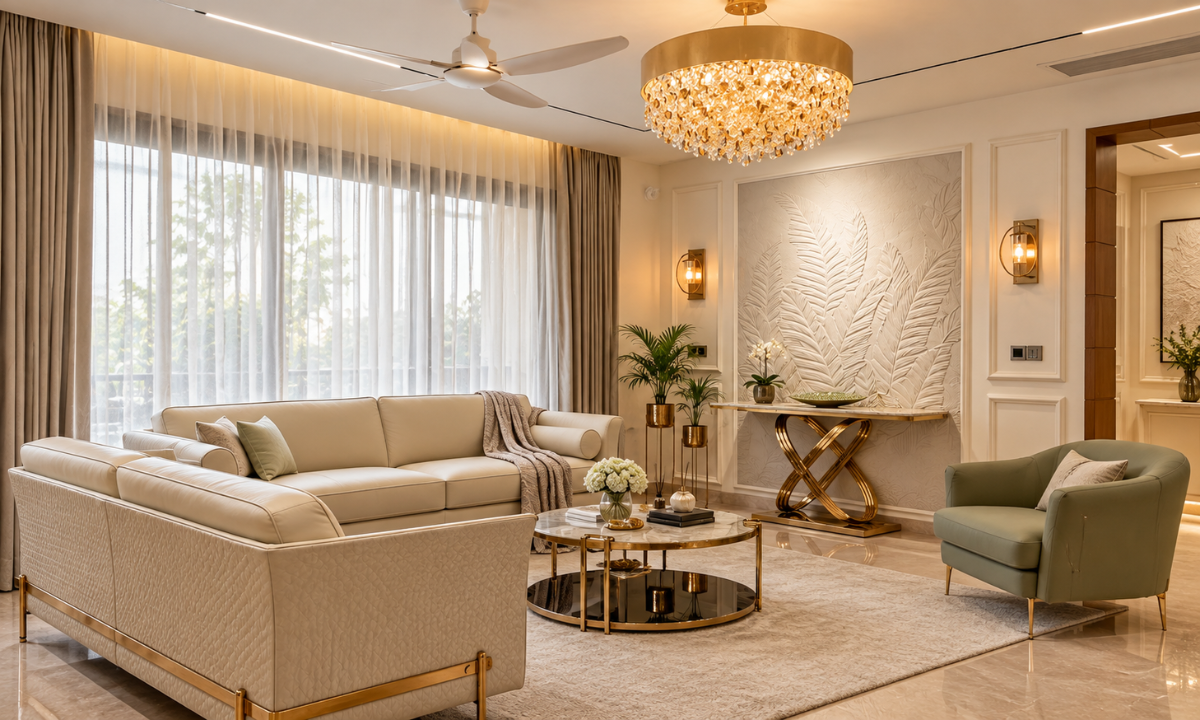
7. Automated Living Room Lighting
Living rooms often require several different lighting moods.
The same room may be used for:
- Watching television
- Reading
- Entertaining guests
- Conversation
- Relaxing
- Listening to music
Each activity benefits from a different lighting arrangement.
Automation allows homeowners to switch between these configurations quickly.
For example:
Relax Scene
Soft cove lighting + wall lights + reduced ceiling lighting
Entertain Scene
Balanced ambient lighting + decorative fixtures + accent lighting
Movie Scene
Low ambient lighting + screen-focused environment + pathway lighting
This makes the living room more flexible.
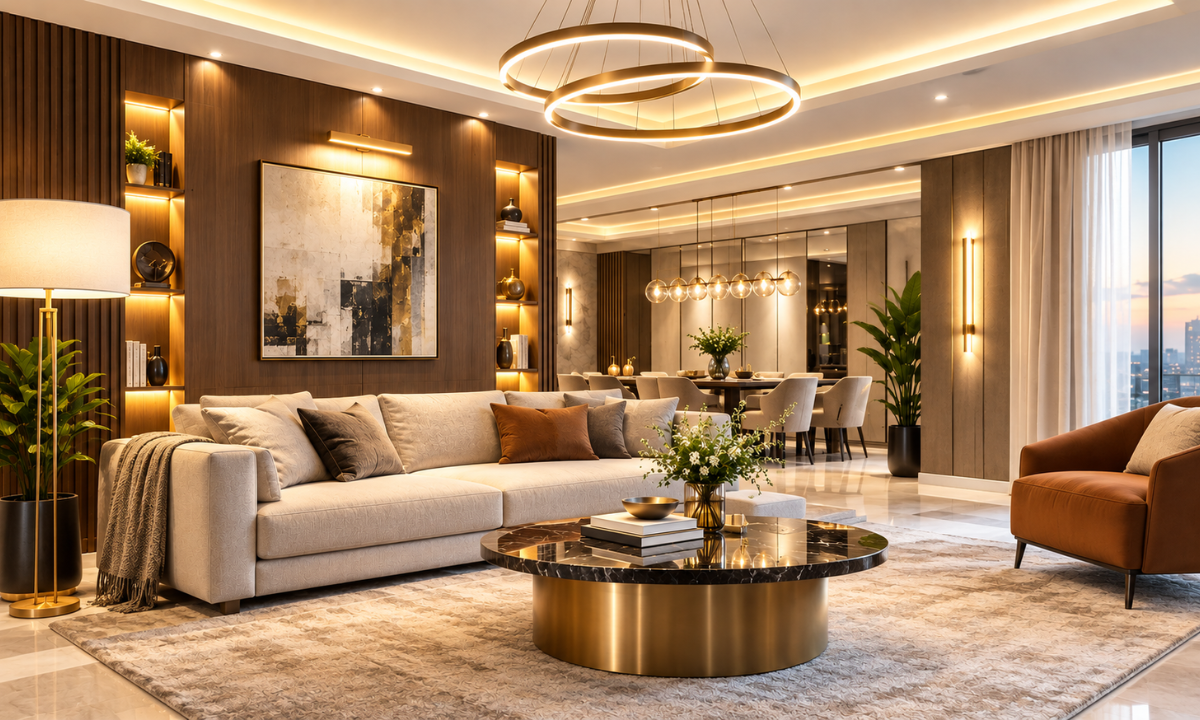
8. Dining Room Lighting Automation
Dining areas benefit from focused lighting.
The dining table should generally remain the visual centre of the room, while surrounding lighting can be reduced.
An automated dining scene could:
- Dim general lighting
- Increase pendant lighting
- Activate wall lights
- Reduce unnecessary background lighting
This creates a more intimate atmosphere for meals and entertaining.
9. Automated Staircase Lighting
Staircases are another area where automation can provide both convenience and functionality.
Motion sensors can activate low-level staircase lighting when someone approaches.
Instead of turning on all the lights, the system can illuminate only the required area.
This can be particularly useful during the night.
Lighting automation can also create a visual feature out of staircase architecture.
10. Automated Entrance Lighting
The entrance creates the first impression of a home.
An automated welcome scene can activate selected lights when residents arrive.
Depending on the system, this could include:
- Entrance lighting
- Foyer lighting
- Accent lighting
- Exterior lighting
- Pathway lighting
The lighting can then return to a normal setting after a predefined period.
This creates a welcoming environment without requiring manual control.
11. Lighting Automation for Luxury Kitchens
Kitchens require different layers of lighting because they combine functional and social activities.
A luxury kitchen may include:
- Under-cabinet lighting
- Pendant lighting
- Ceiling lighting
- Cabinet lighting
- Island lighting
- Decorative lighting
Automation allows these layers to be controlled independently or together.
For example, a cooking scene can provide stronger task lighting, while an entertaining scene can emphasise pendant and decorative lighting.
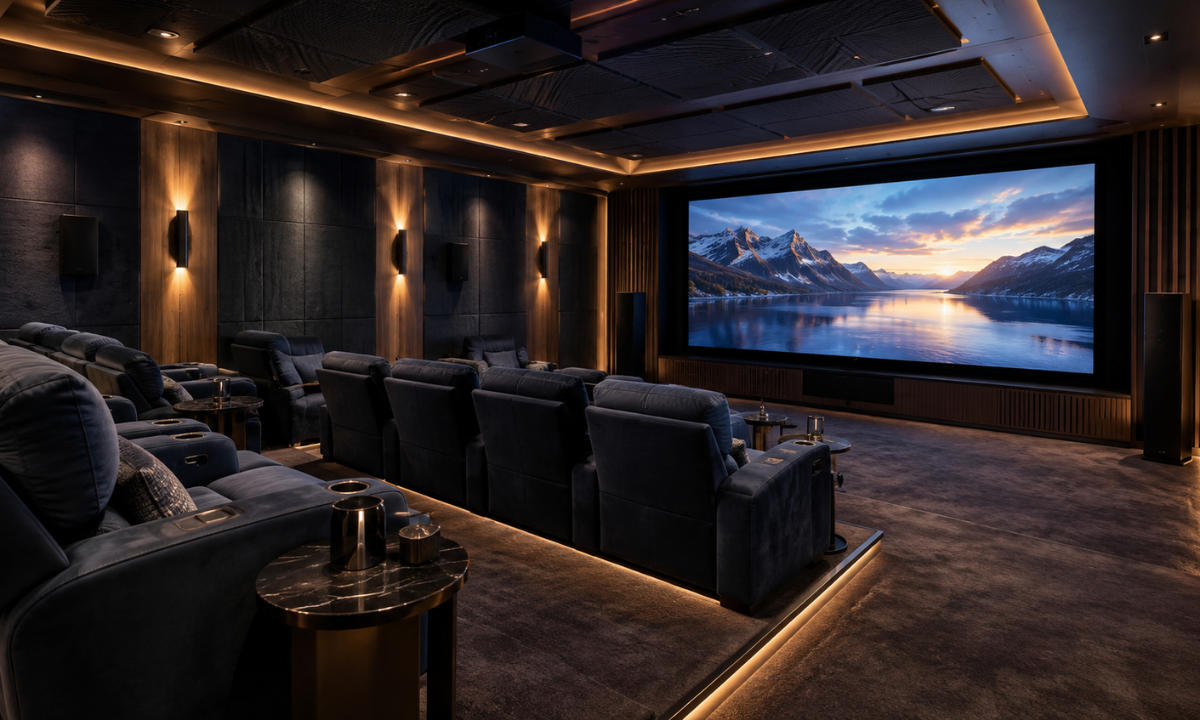
12. Automated Lighting for Home Theatres
Home theatres require carefully controlled lighting.
The ideal environment changes depending on whether the room is being used for watching a film, entering the room or cleaning.
A movie scene could:
- Dim the main lights
- Switch off decorative fixtures
- Activate low-level pathway lighting
- Maintain minimal visibility around seating areas
When the movie ends, the lights can gradually increase.
This creates a more complete entertainment experience.
13. Automated Bathroom Lighting
Bathroom lighting can be automated to provide different levels of illumination.
For example:
Morning
Brighter general lighting
Evening
Warm ambient lighting
Night
Low-level pathway or vanity lighting
Motion sensors can also activate low-level lighting during nighttime visits without turning on the entire bathroom lighting system.
14. Automated Wardrobe and Dressing Room Lighting
Walk-in wardrobes can benefit from sensor-based lighting.
When the door opens or occupancy is detected, the lighting can activate automatically.
Different zones can illuminate separately, including:
- Hanging areas
- Shelving
- Dressing mirrors
- Drawers
- Display sections
This can also reduce unnecessary lighting when the space is unoccupied.
15. Automated Artwork Lighting
Luxury homes often feature artwork and sculptures that deserve carefully controlled lighting.
Automated systems can control these accent lights independently.
This makes it possible to create different visual priorities throughout the day.
For example, artwork lighting can become more prominent during an evening gathering.
It can also be integrated into a general “Entertaining” or “Gallery” scene.
16. Automated Cove Lighting
Cove lighting can provide soft indirect illumination.
When automated and dimmable, it can become one of the most flexible layers of lighting in a luxury interior.
Instead of always operating at full brightness, the cove lighting can change depending on:
- Time of day
- Activity
- Scene
- Natural daylight
- Desired atmosphere
The result is a softer transition between different lighting levels.
17. Lighting Automation With Premium Materials
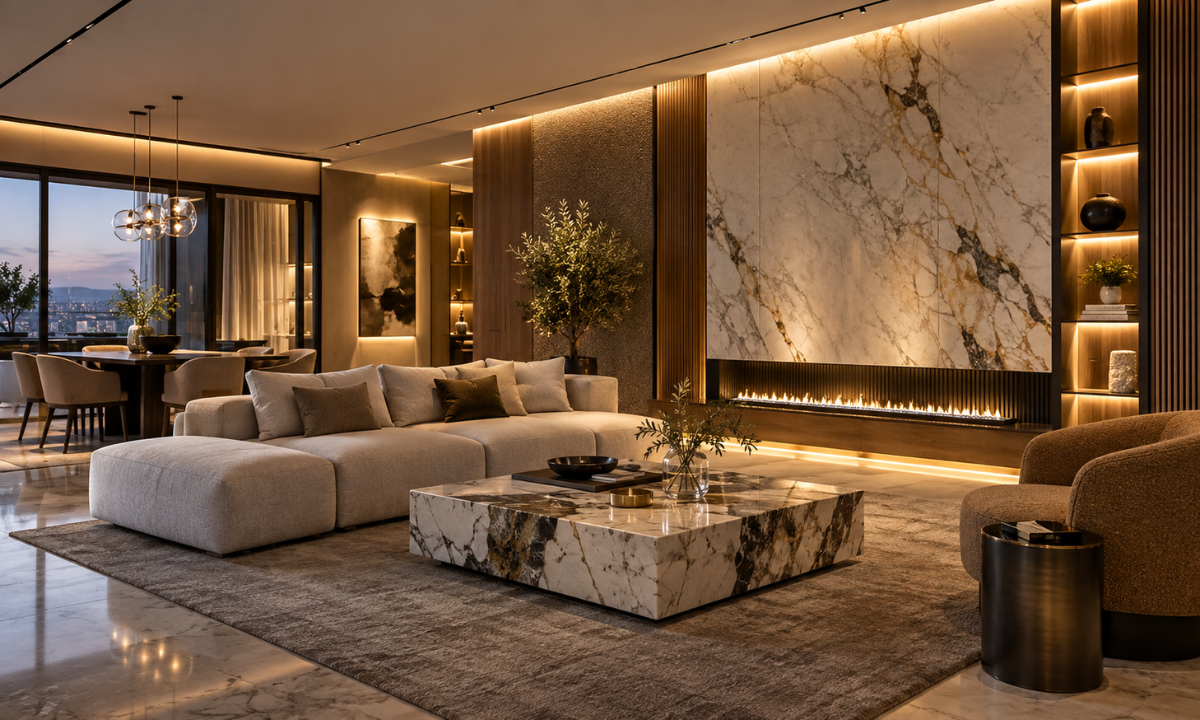
Lighting automation becomes especially effective when it is planned alongside premium materials.
For example:
Italian marble + concealed lighting
can emphasise natural veining.
Veneer + warm lighting
can enhance wood grain.
Textured walls + grazing light
can reveal surface variation.
Metal finishes + accent lighting
can create subtle reflections.
TheAEK’s Premium Veneer Interior Design Guide and Luxury Stone Interior Design Guide explore how premium materials can contribute to sophisticated residential interiors.
The lighting should reveal these materials rather than overpower them.
18. Lighting Automation and False Ceilings
False ceilings often contain multiple lighting layers.
These may include:
- Cove lights
- Spotlights
- Downlights
- Linear lighting
- Decorative fixtures
Automation allows these layers to be combined into different scenes.
For example, a living room could have:
Day Scene: brighter general illumination
Evening Scene: cove + accent lighting
Entertainment Scene: reduced ceiling lighting
Night Scene: low-level lighting
TheAEK’s Luxury False Ceiling Design Guide provides additional ideas for integrating lighting into sophisticated ceiling designs.
19. Motion Sensors and Occupancy Sensors
Sensors can make lighting automation more responsive.
Motion sensors detect movement, while occupancy sensors can determine whether a space is being used depending on the system and sensor technology.
They can be useful in areas such as:
- Walk-in wardrobes
- Bathrooms
- Corridors
- Staircases
- Utility rooms
- Storage areas
However, sensors should be used thoughtfully.
Not every room needs automatic activation. In some spaces, manual scene controls may provide a better experience.
20. Lighting Automation for Outdoor Spaces
Luxury lighting automation can extend beyond the interiors.
Outdoor lighting can be integrated into:
- Gardens
- Terraces
- Balconies
- Pool areas
- Driveways
- Pathways
- Outdoor entertainment areas
Automated schedules can turn outdoor lights on and off according to programmed times.
Scenes can also coordinate exterior and interior lighting during evening events.
Lighting Automation and Energy Efficiency
Automation can also help reduce unnecessary lighting usage.
For example:
- Lights can switch off when spaces are unoccupied.
- Outdoor lighting can follow schedules.
- Different rooms can operate independently.
- Brightness can be reduced when full output is unnecessary.
- Daylight can be used where appropriate.
The objective is not simply to automate every light.
The objective is to provide the required illumination when and where it is needed.
How to Plan Lighting Automation During Interior Design
Lighting automation should ideally be planned before the interior work begins.
The design team should determine:
- Which areas require automation
- Which lights should be dimmable
- Which lights should be grouped together
- Where keypads should be positioned
- Which areas require sensors
- Which scenes are useful
- How lighting interacts with curtains
- How lighting interacts with entertainment systems
- Where control equipment will be installed
- How wiring and electrical requirements will be integrated
Planning these elements early can prevent unnecessary changes later.
How TheAEK Approaches Luxury Lighting Automation
At TheAEK, lighting is treated as an important part of the interior architecture rather than simply an electrical requirement.
The design process can consider:
- Architectural proportions
- Material finishes
- Furniture placement
- Natural daylight
- Ceiling design
- Wall treatments
- Artwork
- Lifestyle requirements
- Lighting scenes
- Automation controls
This approach allows technology to remain discreet while the lighting itself becomes part of the overall design experience.
For example, a marble feature wall may require a completely different lighting strategy from a veneer wall.
Similarly, a bedroom requires a different lighting experience from a formal living room.
The automation system should support these differences rather than applying the same lighting logic throughout the house.
Common Mistakes to Avoid With Lighting Automation
Automating Everything
Not every light needs automation. Focus on areas where automation genuinely improves convenience.
Using Too Many Scenes
A system with dozens of complicated scenes can become difficult to use.
Keep frequently used scenes simple.
Ignoring Manual Controls
Homeowners should still have intuitive physical controls for important lighting functions.
Planning Controls Too Late
Switches, keypads and sensors should be considered during the interior design stage.
Choosing Fixtures Without Considering Dimming
Not every lighting fixture works with every control system. Compatibility should be checked during planning.
Using Excessive Brightness
Luxury interiors generally benefit from layered lighting rather than simply increasing brightness.
Ignoring Material Finishes
The same light can look very different on marble, veneer, paint or textured surfaces.
Lighting should always be designed with the materials in mind.
Luxury Home Lighting Automation Checklist
Before implementing an automated lighting system, consider:
- Lighting zones
- Dimmable fixtures
- Lighting scenes
- Control keypads
- Mobile control
- Sensor requirements
- Colour temperature
- Natural daylight
- Artwork lighting
- Accent lighting
- Cove lighting
- Outdoor lighting
- Electrical planning
- Control-system compatibility
- Future expansion
A well-planned system should remain simple for the homeowner while handling complex functions behind the scenes.
Final Thoughts
Luxury home lighting automation is about much more than turning lights on and off automatically.
It allows lighting to respond to different moments throughout the day.
A living room can transition from bright daytime illumination to warm evening ambience. A bedroom can create a relaxing night scene. A dining room can focus attention on the table. A staircase can illuminate only when someone approaches.
The technology remains in the background while the homeowner experiences the result.
For a luxury interior, this distinction is important.
The objective should not be to showcase how much technology has been installed. The objective should be to create lighting that feels natural, comfortable and perfectly suited to the space.
At TheAEK, lighting automation can be integrated with architecture, premium materials, furniture and interior detailing to create a cohesive residential environment.
When technology and design are planned together from the beginning, lighting becomes more than illumination. It becomes an important part of the experience of the home.
Frequently Asked Questions
What is luxury home lighting automation?
Luxury home lighting automation uses smart controls, sensors and connected lighting systems to manage different lights, brightness levels and lighting scenes throughout a home.
What can be controlled through lighting automation?
Depending on the system, homeowners can control ambient lighting, accent lighting, chandeliers, wall lights, cove lighting, outdoor lighting, staircase lighting and other compatible fixtures.
Can luxury lighting be controlled from a phone?
Yes. Compatible lighting automation systems can provide mobile control in addition to physical keypads and other interfaces.
Can lighting automation control brightness?
Yes. Compatible dimmable fixtures can be adjusted to different brightness levels.
What are lighting scenes?
Lighting scenes are predefined combinations of lighting settings designed for activities such as dining, entertaining, watching movies, relaxing or sleeping.
Is lighting automation useful for bedrooms?
Yes. Bedrooms can use automated scenes for waking, reading, relaxing and sleeping, as well as low-level nighttime lighting.
Can lighting automation work with false ceilings?
Yes. Cove lighting, spotlights, downlights and other ceiling lighting can be integrated into automation systems when the fixtures and control system are compatible.
Can lighting automation work with marble and veneer?
Yes. Lighting can be designed specifically to highlight the texture, grain and natural characteristics of materials such as marble, stone and veneer.
Does lighting automation save electricity?
It can help reduce unnecessary lighting use through schedules, sensors, zoning and appropriate brightness levels. Actual energy savings depend on the system and how it is used.
When should lighting automation be planned?
Ideally, lighting automation should be planned during the early interior design and electrical planning stages so that wiring, controls, sensors and fixtures can be coordinated properly.
Does TheAEK design automated lighting for luxury interiors?
TheAEK integrates lighting, automation, architectural detailing and premium materials as part of its approach to luxury residential interiors.